Helping global K-pop fans improve their movement—and stay motivated to practice
I designed a camera-based AR experience that helps independent learners practice with a virtual instructor, understand what to correct, and use what they learned in multiplayer dance games.
Product Designer
6 months (Mar–Aug 2025)
1 Product Designer · 1 Visual Designer · 1 3D Designer · 2 Developers
AR · iPad / web
Research · Product Definition · UX/UI Design · Prototyping · Testing
02 Context
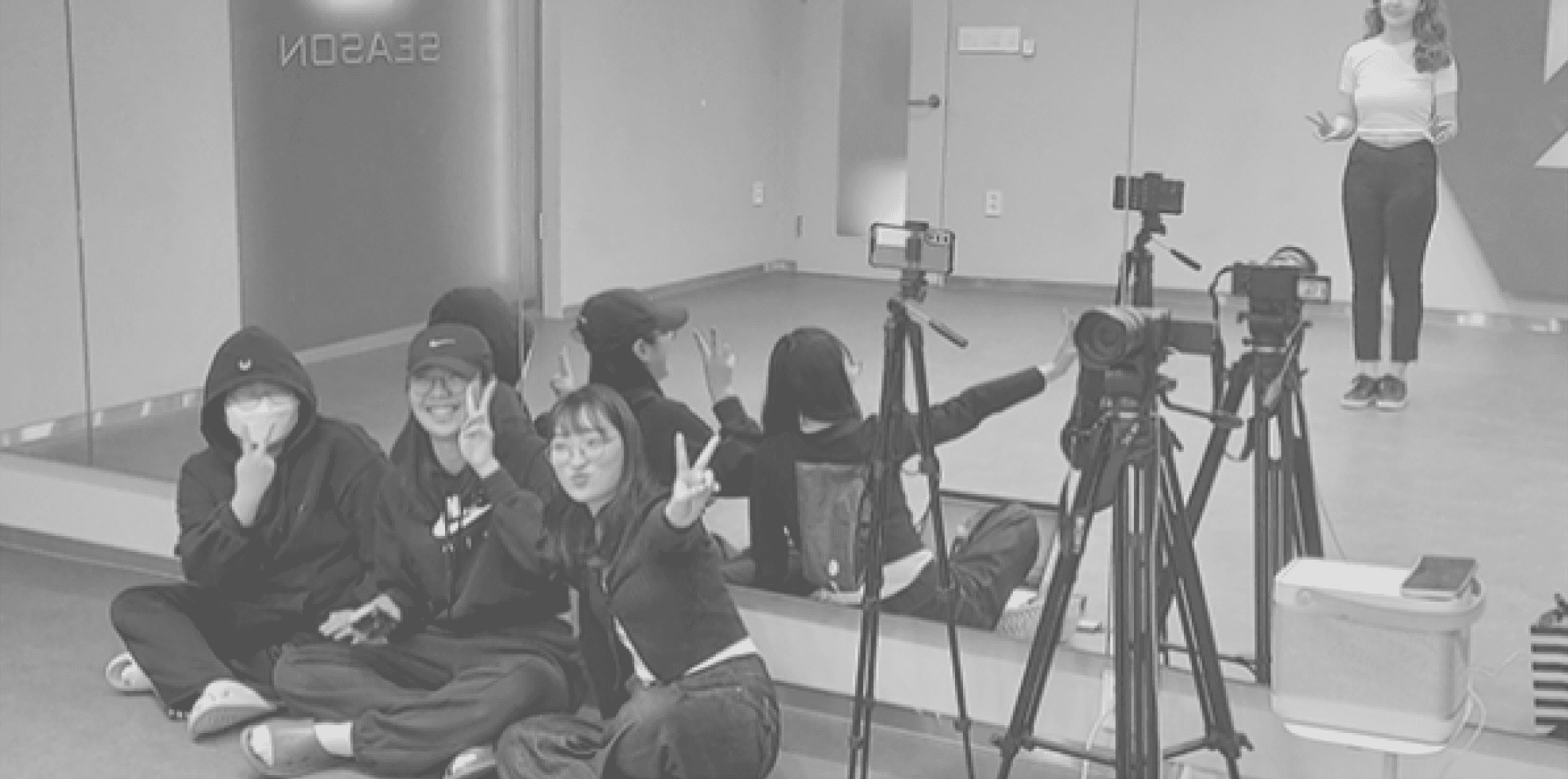
Learning K-pop choreography abroad often meant practicing alone with online videos
YouTube and TikTok made choreography accessible anywhere. However, learners without access to local classes had to control the lesson, compare their movement, identify mistakes, and maintain motivation by themselves.
03 Problem
3 problems made practice difficult
I interviewed 6 independent K-pop learners and surveyed 42 people with dance-learning experience.
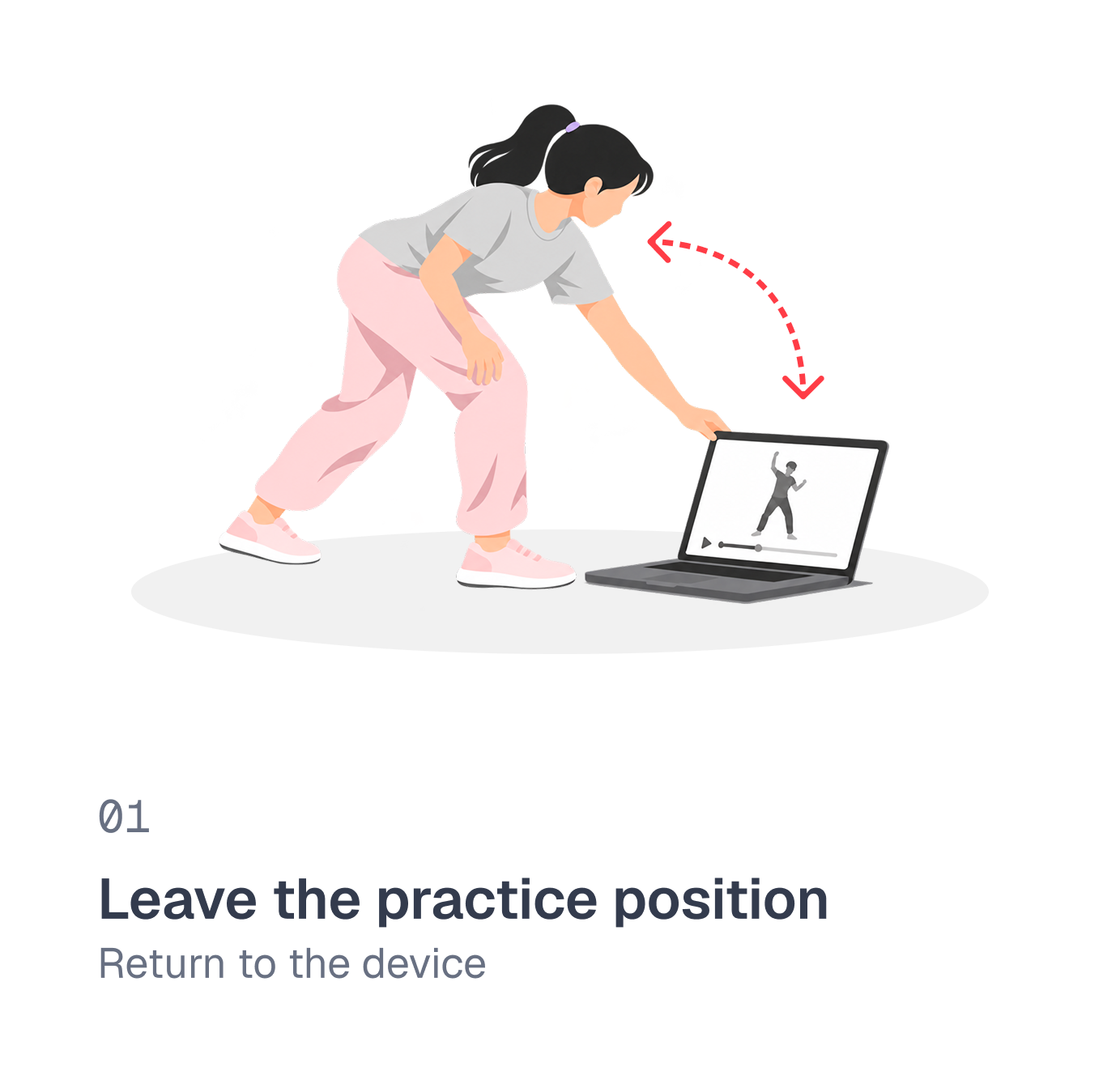
1. Repeated screen adjustments disrupted focused practice
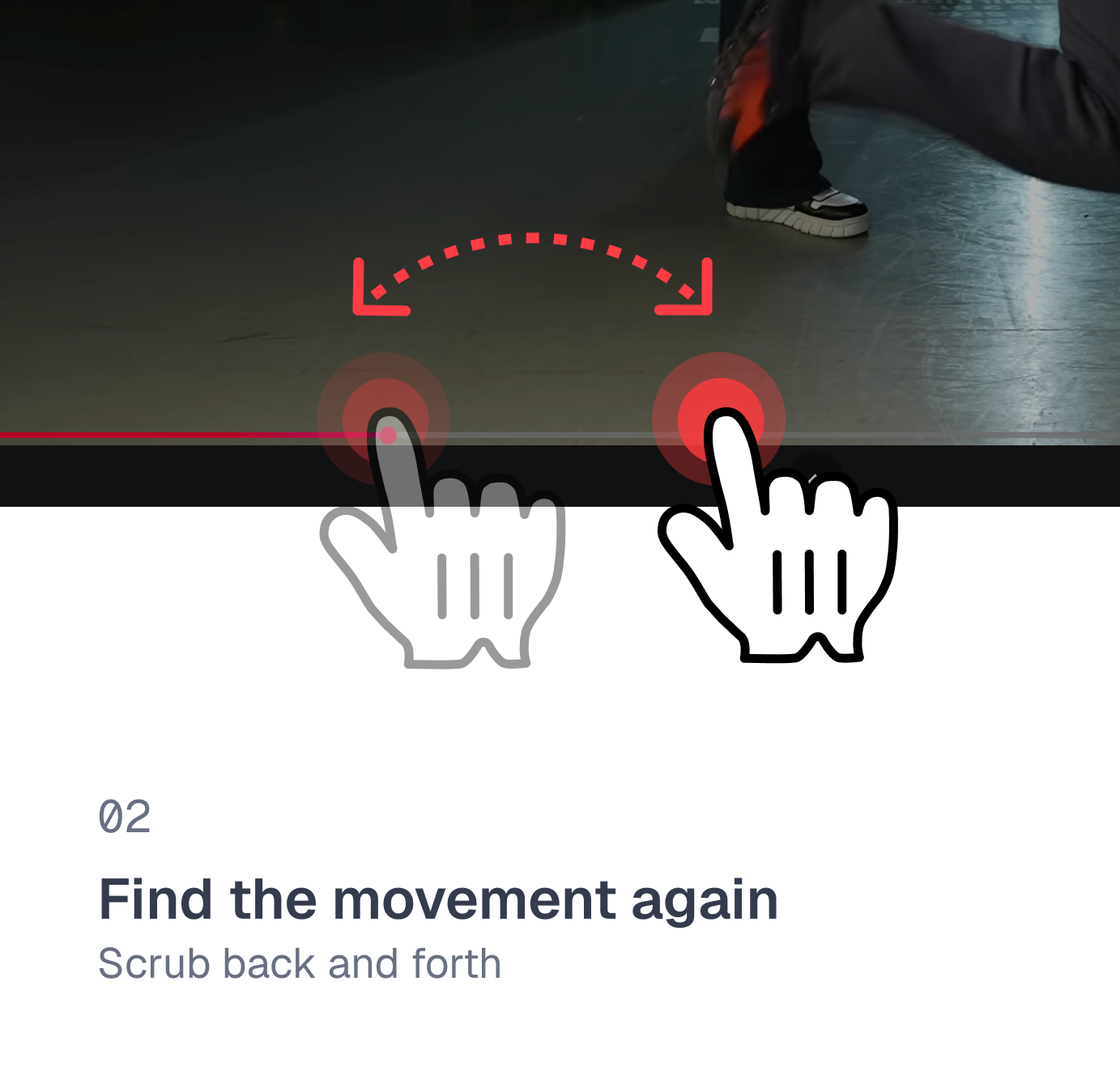
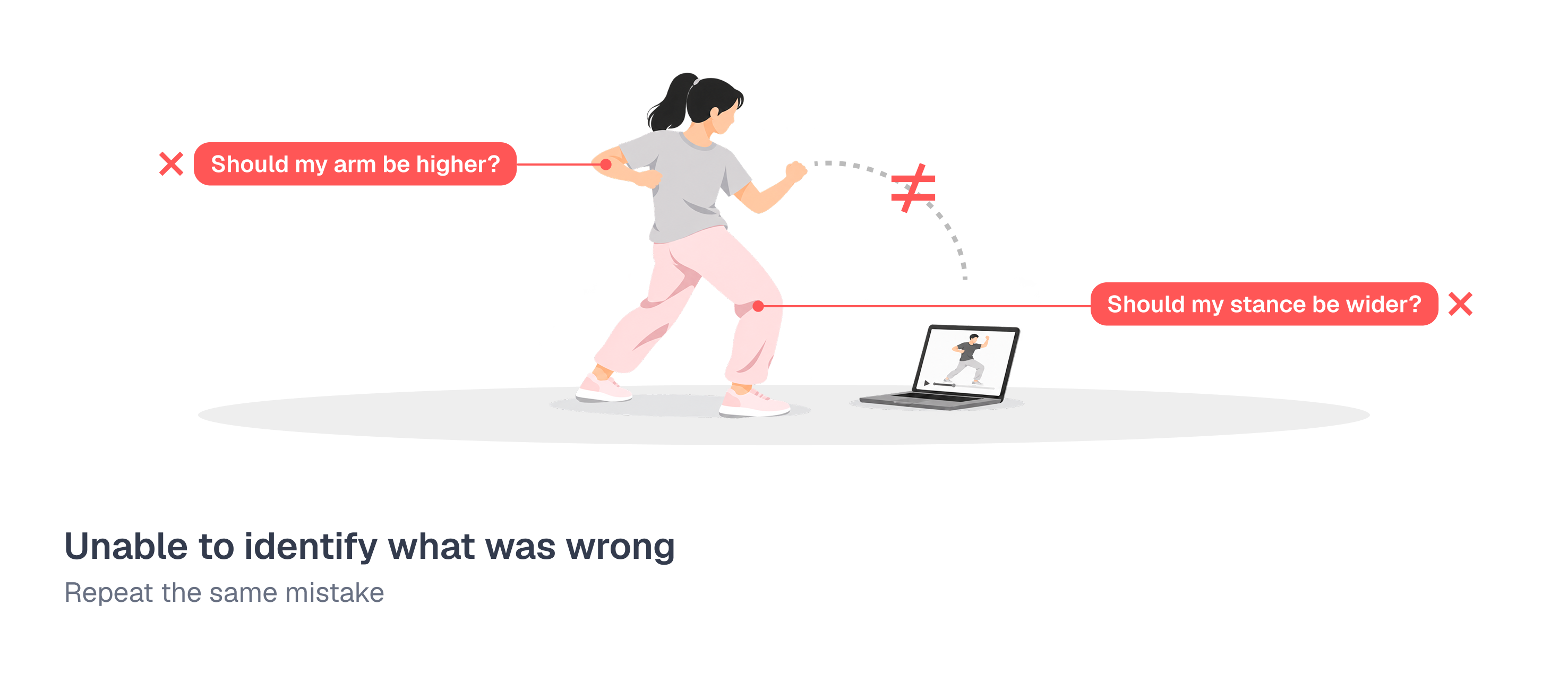
2. Observation did not lead to correction
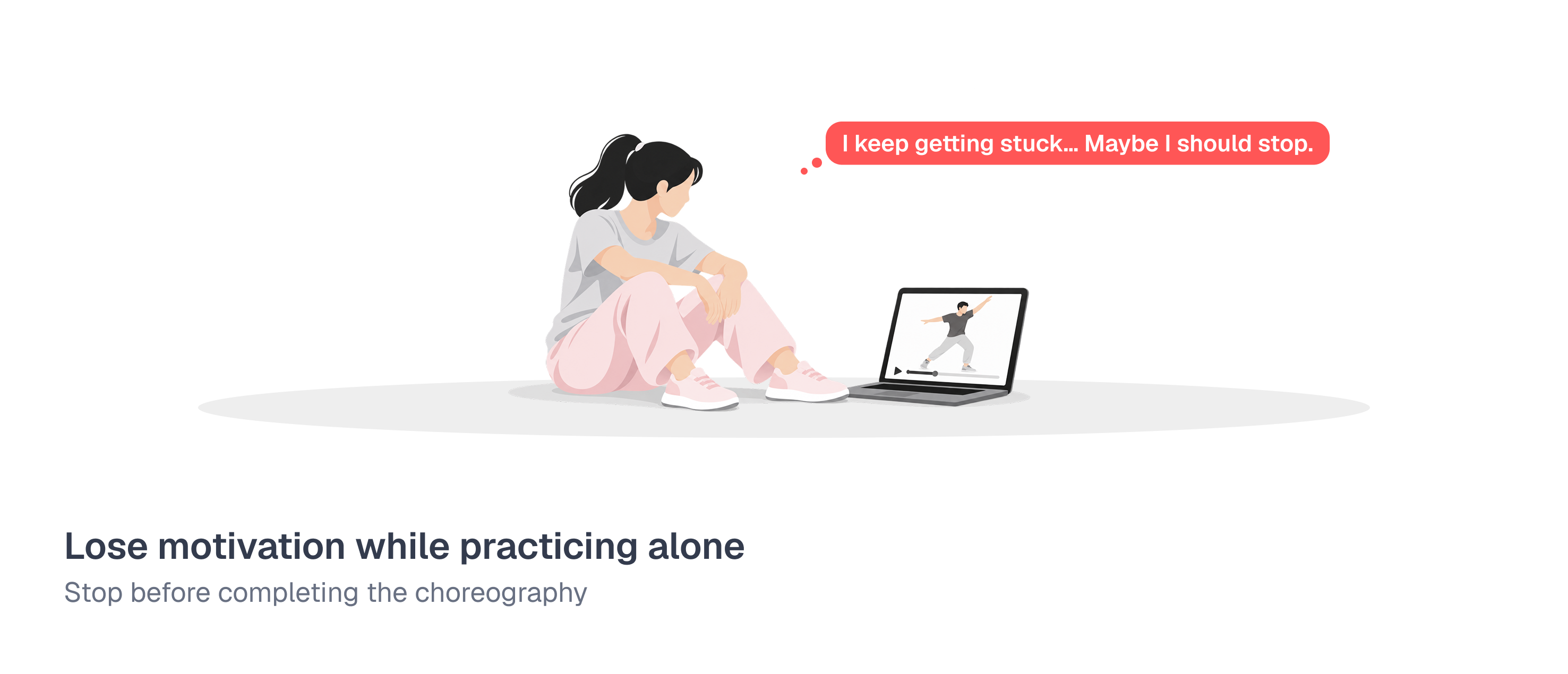
3. Practice often ended before learners completed the choreography
04 Goals & Design Principles
01 Sustain focused practice
Design principle
Keep frequent lesson adjustments within reach of the learner’s practice position.
Success condition
Reduce how often—and how long—learners stop moving to control the lesson.
02 Turn uncertainty into a next action
Design principle
Show learners which movement to correct and how to adjust it.
Success condition
Learners can identify one specific adjustment before their next attempt.
03 Sustain motivation beyond practice
Design principle
Create a motivating payoff for completing the choreography.
Success condition
Learners feel motivated to complete the choreography and return to practice.
05 Design Exploration
I explored how each requirement should shape the interface
5.1 Choosing the practice medium
Which medium best supports full-body movement?
Exploration
The initial concept used VR to place learners inside a virtual dance studio. Interviews with eight VR/MR users revealed three conflicts with full-body practice: headset discomfort, limited upper-body movement, and reduced spatial awareness.
Design decision
I moved from wearable VR to camera-based AR to preserve movement freedom and awareness of the learner’s surroundings.
Trade-off
Removing the headset reduced immersion, but introduced a new constraint: the practice view had to remain readable from a distance.
VR
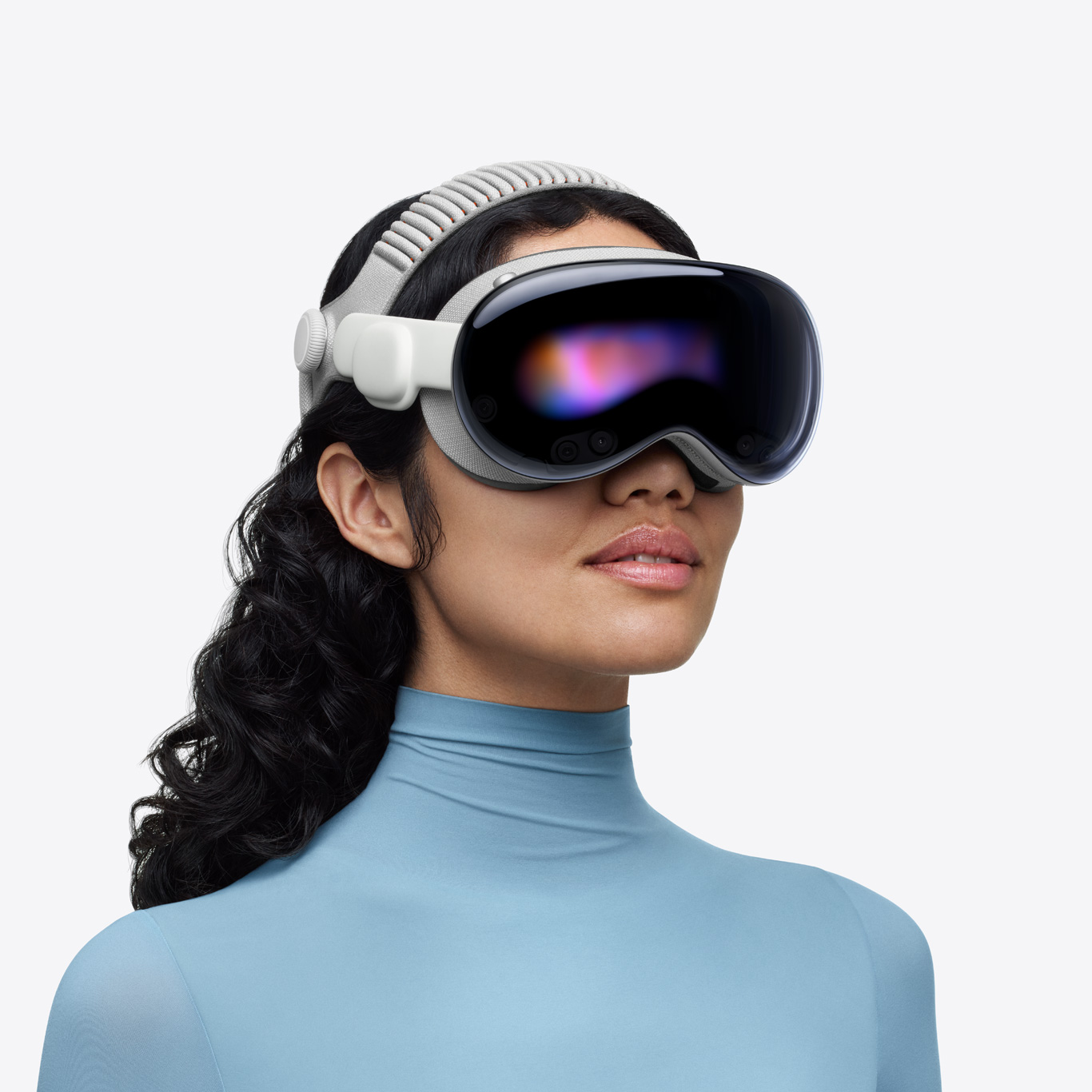
Movement constraints
- • Headset discomfort
- • Limited upper-body movement
- • Reduced spatial awareness
Camera-based AR
5.2 Maintaining practice flow
How can learners adjust the lesson while staying in practice?
Exploration
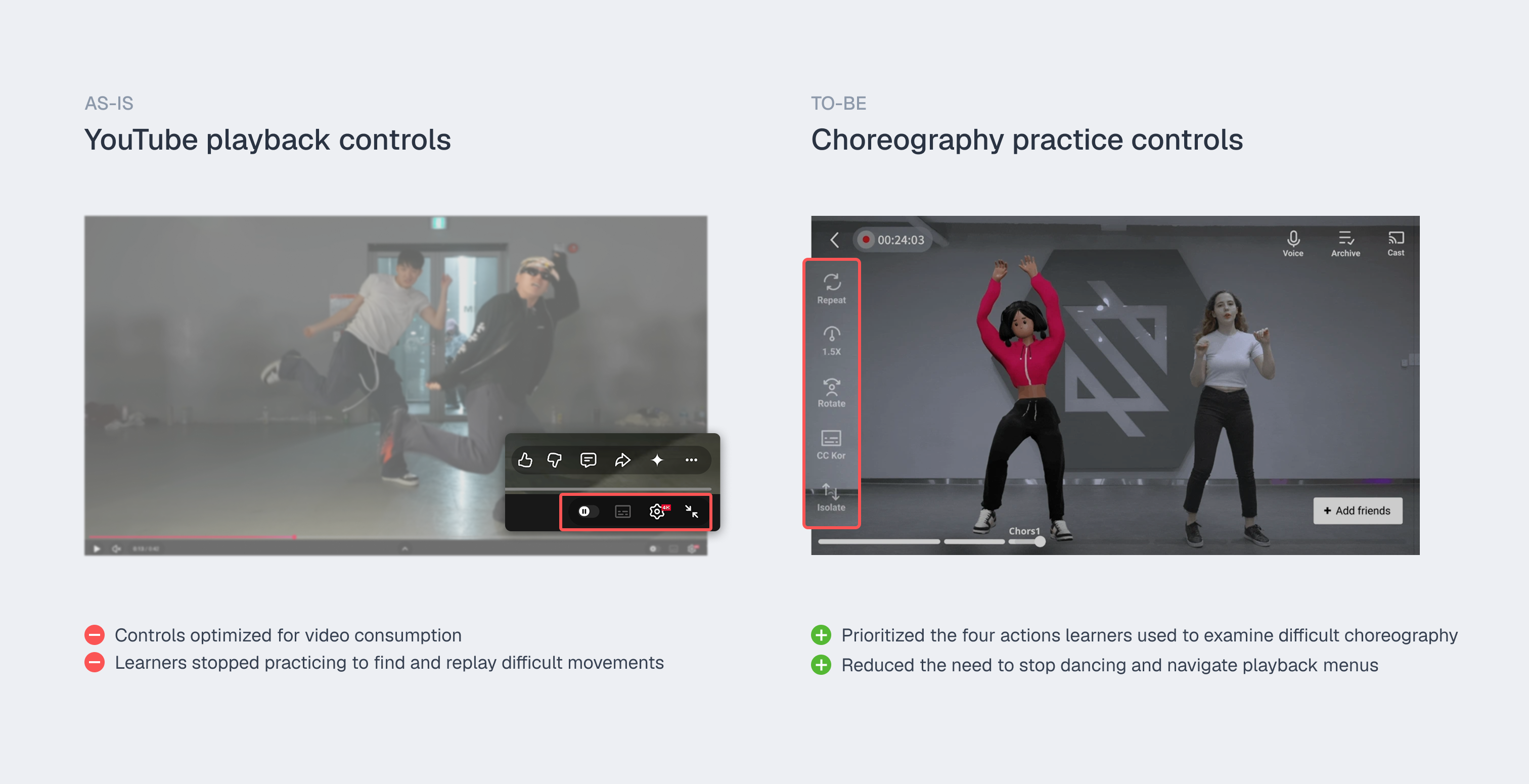
With YouTube, learners had to stop moving, return to the device, and navigate playback controls whenever they needed to examine a difficult movement. I explored how to bring the most frequent adjustments into the active practice view.
Design decision
I kept Repeat, Speed, Rotate, and Isolate visible in one control area to reduce the steps required to adjust the lesson and resume movement.
Trade-off
Persistent controls occupied more of the viewing area, but were designed to reduce how often—and how long—learners left the practice flow.
5.3 Movement feedback
How should feedback support the learner’s next attempt?
Exploration
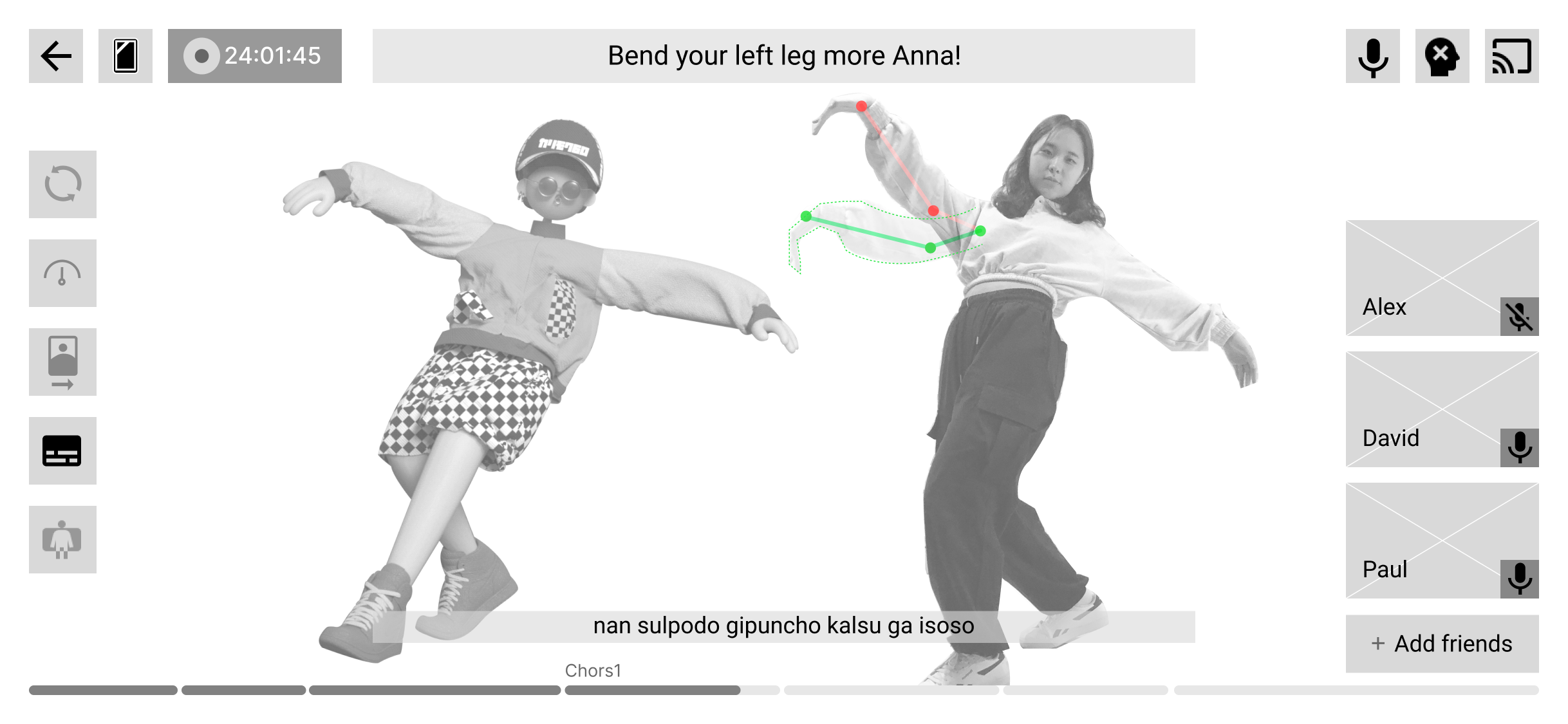
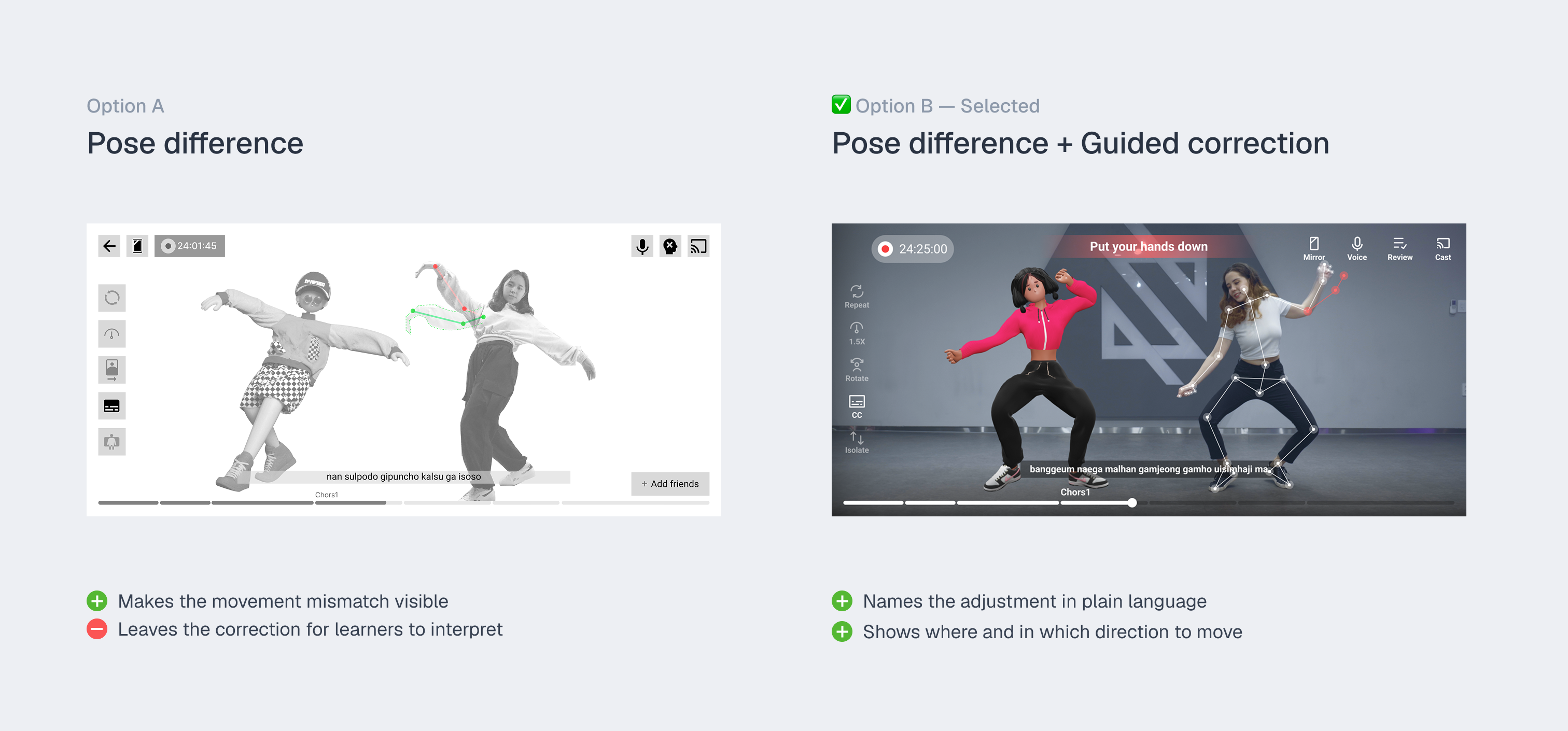
I compared a pose-difference view with a guided correction. The first made the mismatch visible, but learners still had to translate it into an action. The second paired a short instruction with a body-specific guideline.
Design decision
I chose guided correction to translate a detected movement difference into one concrete adjustment for the next attempt.
Trade-off
The added instruction and guideline occupied more of the practice view, but reduced the interpretation required before retrying.
5.4 Sustaining motivation
What could motivate learners to complete the choreography and return?
Research insight
76.2% of respondents identified dancing with others as a motivating factor.
Exploration
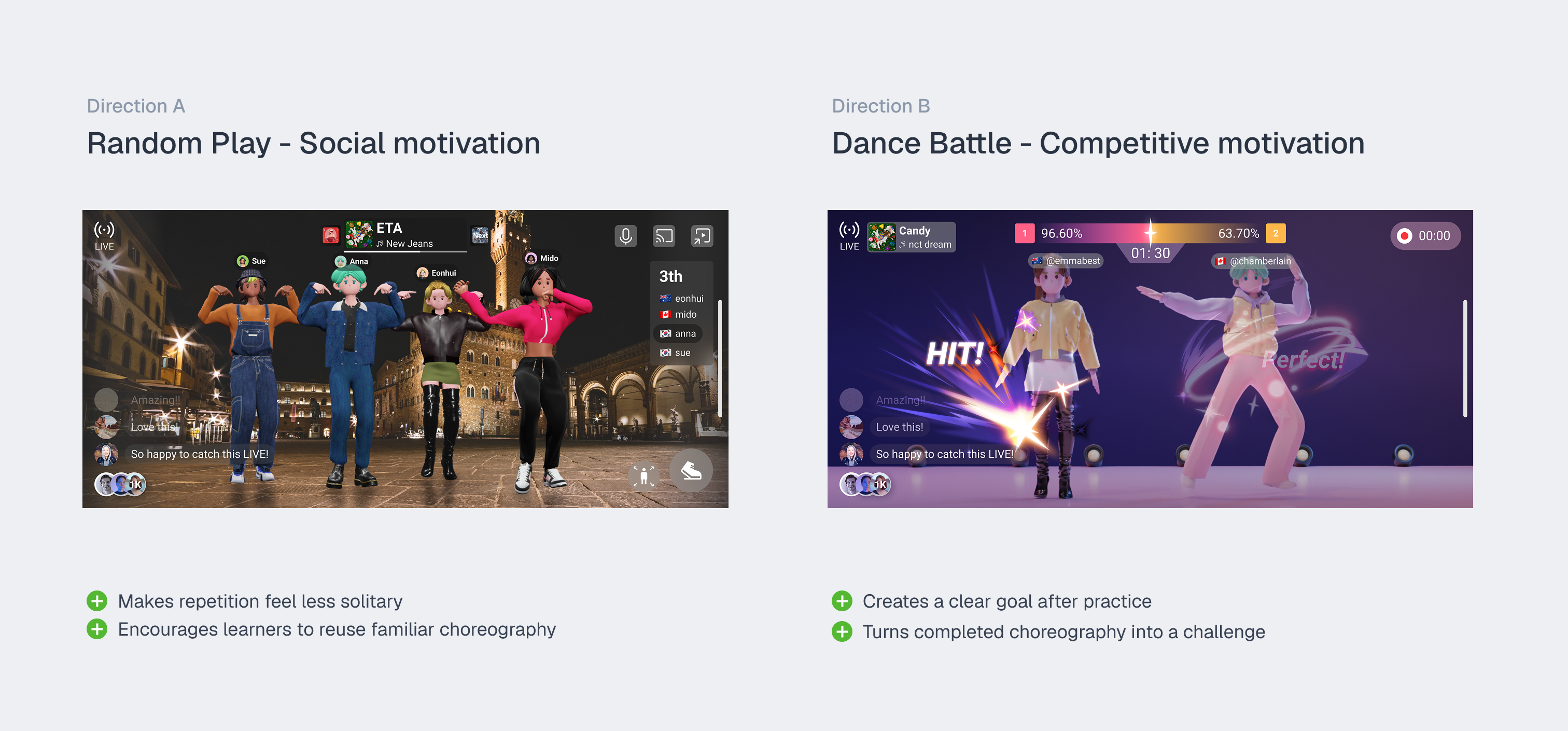
I explored how the energy of dancing with others could create a meaningful payoff without interrupting self-paced practice.
Design decision
I kept learning individual and turned completed choreography into a shared game experience through Dance Battle and Random Play.
Trade-off
Social interaction begins after practice rather than during it, but gives learners a reason to complete the choreography and return.
06 User Testing
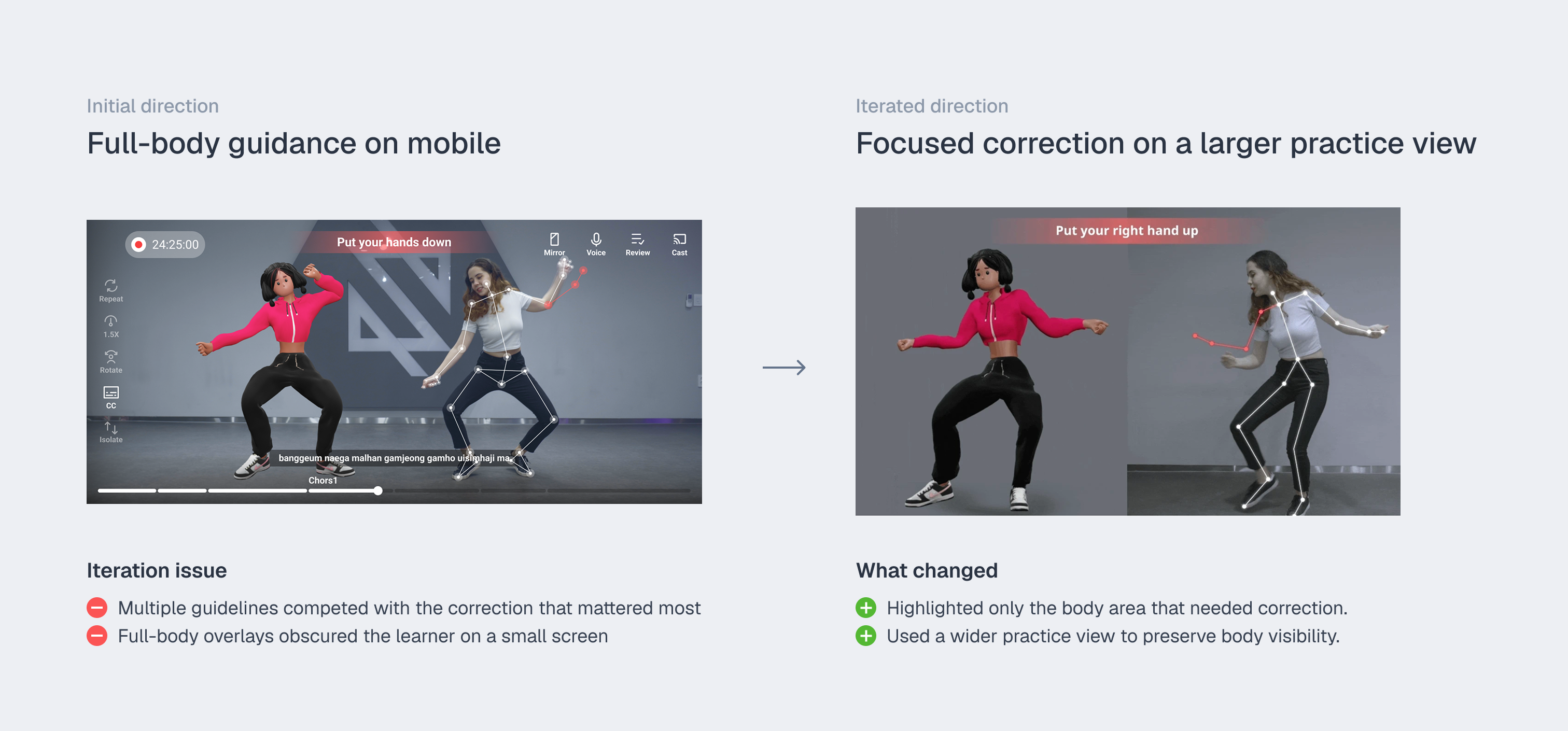
Too many guidelines obscured the key correction
Iteration
I simplified the feedback to one incorrect body area, one instruction, and one directional guideline. I also moved the practice view to a larger screen to preserve body visibility.
Trade-off
The larger-screen experience was less portable, but made movement comparison and correction easier to read from a practice distance.
07 Final Design
1. Keep essential adjustments visible throughout practice
Prioritized the four actions learners needed while examining movement: Repeat, Speed, Rotate, and Isolate.
Minimized the navigation required to adjust the lesson and resume movement.
2. Show what was wrong, where it happened, and what to try next.


Highlight only the body area that needs correction to focus attention on the key difference.
Pair one short instruction with a body-specific directional guideline to show how to adjust on the next attempt.
3. Motivate learners to keep learning the choreography
Practice often ended before learners completed the choreography. To address this, I explored how social play could give learners a reason to keep going beyond solo practice.
Dance Battle — Competitive payoff
Pair dance battles with clear accuracy feedback, so learners can see how they performed and stay motivated to improve.

Random Play — Motivation through dancing together
Let learners draw inspiration from others’ dancing and find the motivation to join in.
08 Validation
Evidence changed the concept; it did not prove every product assumption.
01
Validated direction
Eight VR/MR interviews identified comfort, movement, and safety constraints strong enough to reverse the platform decision from VR to camera-based AR.
02
Supported direction
A 42-person survey supported social participation as a motivation mechanism and informed Dance Battle and Random Play concepts.
03
Still to validate
Pose-detection accuracy, learning improvement, repeat usage, and willingness to participate socially require testing with a functional prototype.
09 Impact
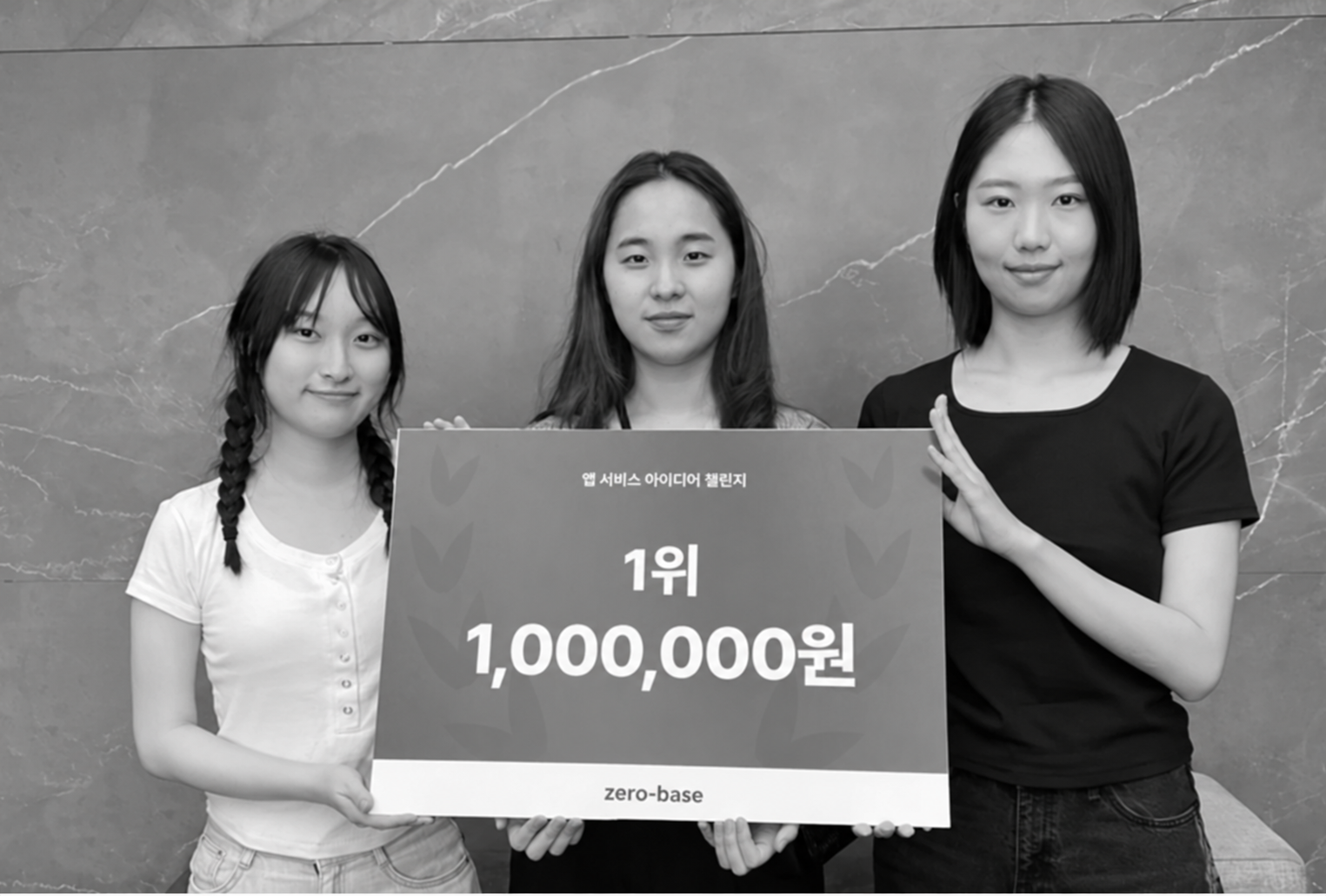
The concept won the grand prize and clarified the next validation priorities.
The service concept won the grand prize in a planning competition, where judges recognized its combination of accessibility and technical feasibility. This was concept validation—not evidence of product-market fit or learning effectiveness.
Grand Prize
Service planning competition
8 + 42
Interview and survey participants
VR → AR
Platform direction changed through research
1
End-to-end concept prototype
The project taught me to treat immersive technology as a means, not the product goal. The strongest decision was not adding AR; it was abandoning VR when research showed that the medium conflicted with the physical reality of dancing.